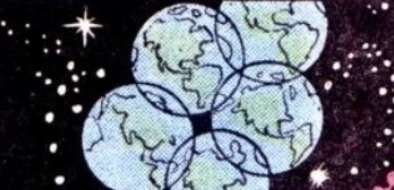
Earths seemed to be infinitely common in every multiverse.[1]
A multiverse might have best been described as a "dimensional container," as there were theoretically an almost infinite amount of universes located in it, each of which existed in their own dimension.
Just as a multiverse was likely infinite, it was also theorized that there may have been an almost infinite amount of multiverses within the greater omniverse.
History
Earth 1956
This section has not yet been written.
Background Information


E. Nelson Bridwell had originally intended for both the Superfriends animated series and comic books to be set in the multiverse that would eventually be destroyed during the Crisis on Infinite Earths maxi-series from DC Comics.
To be more specific, the setting was intended to be Earth-One. Although this was never made canon, there were many similarities in continuity between the two universes, which did indeed imply that they were one and the same.
The Crisis led to the creation of what was most commonly referred to as the Post-Crisis multiverse, with Earth-One combining with a variety of other Earths to be a New Earth of a completely new multiverse.
Well before this occurred however, many Super Fans found it to be clear that there was no way that the Super Friends could have actually existed on Earth-One, as there were far too many contradictions in storytelling. One example of a clear contradiction was the fact that on Earth-One, the Jack Nimball version of the Toyman was killed by Winslow Schott, who was the original. This happened well before the Challenge of the SuperFriends TV series was on the air, and he's shown to be very much alive.
This is just one example that seems to prove that these are clearly two completely separate universes, despite their similarities. Eventually, Super Fans adopted the name Earth-1A, which was never official, nor was it known what multiverse it was actually part of.
It wasn't until December 22, 2022 when the name of the universe that the Superfriends inhabited was revealed, as well as what multiverse it was part of. The answer to this question was told in Dark Crisis: Big Bang # 1 (February 2023). In that comic, we learn the name of the universe is Earth 1956, and that it was part of the Flashpoint multiverse.
Still, there has been some slightly confusing developments since then, such as the Superfriends' universe appearing in the Tomorrowverse series' Justice League: Crisis on Infinite Earths trilogy. In these films, the universe was referred to as Earth-508. This is strange, since typically Earth-508 is depicted as the homeworld of a completely different version the characters, as these are the DC Super Friends from the comics based upon the Imaginext toyline.
Also, since the Tomorrowverse depicts the complete and utter destruction of the multiverse, this makes it seem like it can't be the Flashpoint multiverse...which came into existence and was destroyed in a completely different manner. It's vaguely possible that one might call it the same multiverse, but just in an alternate timeline; as manipulating with time often led to a number of continuity changes over the course of DC Comics history.
In any case, the most official answer we have to where Earth 1956 was located is either the Flaspoint Multiverse or the multiverse depicted in the Tomorrowverse series, although there's no way to know for sure what timeline the animated series and comic books were set in...nor can we necessarily assume that the Tomorrowverse's depiction of the multiverse is supposed to be the same one, just in a different timeline.
In any case, it's too confusing, and the Super Friends Wiki is not obligated to figuring out what multiverse (let alone what timeline of that multiverse) it belongs to. For now, we shall just say that the homeworld of the Superfriends is Earth 1956, which is located in some unknown multiverse.
References
- ↑ As seen in Beyond the Silent Night, originally published in Crisis on Infinite Earths # 7 (October 1985); which was reprinted in Super Powers # 5 (May 5, 1987).
External Link
- Multiverse at the DC Database
- Multiverse at Wikipedia